

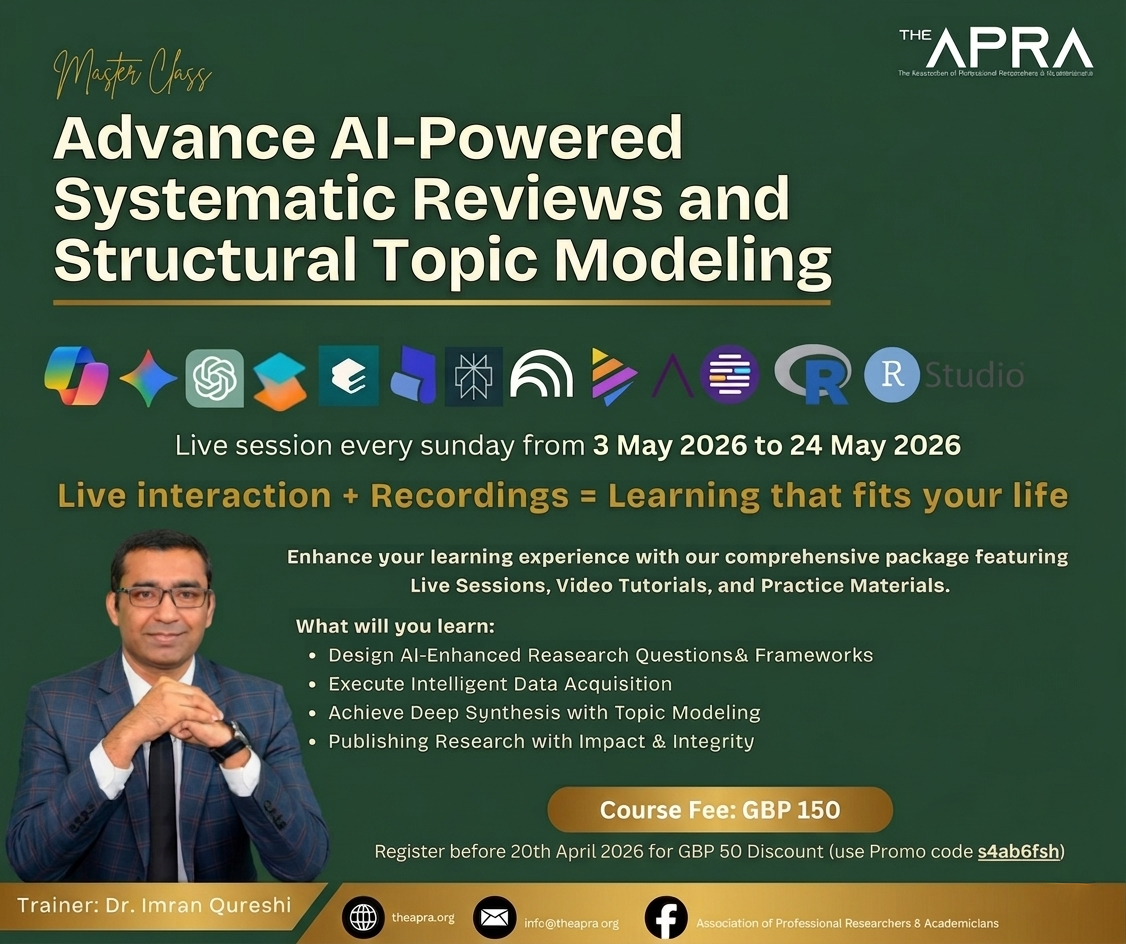
Advance AI-Powered Systematic Reviews and Structural Topic Modeling

Wishlist Share

About Course

This advanced masterclass moves beyond foundational AI applications, empowering you to harness sophisticated artificial intelligence, including powerful topic modeling techniques like Latent Dirichlet Allocation (LDA) and Structural Topic Modeling (STM), to conduct systematic literature reviews with unparalleled depth and efficiency.

You will journey from crafting highly precise, AI-refined research questions to deploying intelligent data acquisition strategies using the latest AI tools for comprehensive searching, screening, and crucial metadata collection. Dive deep into the analytical core of modern research by mastering LDA and STM to uncover latent thematic structures and trends within vast literary corpora. Learn to synthesize these complex findings and develop robust theories, all augmented by AI-driven knowledge discovery.

The course culminates in mastering AI-assisted reporting, creating impactful data visualizations, and navigating the ethical landscape of AI in academic writing. As a capstone to your advanced learning, you will be introduced to the transformative concept of AI-powered Living Systematic Reviews, preparing you to maintain and contribute to continuously updated evidence syntheses in rapidly evolving fields.

Show More

What Will You Learn?

  • 1. Research Question Developmment:
  • Prompt Engineering for Academics: Move beyond simple queries to "Chain-of-Thought" prompting for complex literature scoping.
  • Systematic Gap Discovery: Use AI discovery tools (Elicit, Sciespace) to identify "white spaces" and unaddressed niches in your field.
  • Protocol Development: Design rigorous research questions using frameworks like PICO or SPIDER, refined by AI logic.
  • 2. Intelligent Data Acquisition & Screening:
  • Semantic Search Mastery: Leverage neural retrieval to find relevant papers that traditional keyword searches miss.
  • Automated Screening: Use "Active Learning" models to reduce the time spent on Title/Abstract screening by up to 70%.
  • Metadata Harvesting: Efficiently export and clean thousands of records, preparing them for computational analysis.
  • 3. Advanced Computational Synthesis (STM)
  • R for Researchers: A code-friendly introduction to Structural Topic Modeling (STM) in R Studio—no prior coding expertise required.
  • Latent Pattern Discovery: Move beyond manual themes to identify hidden structures and evolving trends in your corpus.
  • Data Visualization: Create publication-ready plots, including topic prevalence, word clouds, and covariate analysis (e.g., how topics change over time).
  • 4. Academic Impact & Ethical Integrity
  • The AI-Enhanced Manuscript: Learn how to weave complex STM data into a compelling narrative for top-tier journals.
  • Ethics & Transparency: Master the "AI Disclosure Protocol" to satisfy the latest transparency requirements from major publishers like Elsevier and Springer.
  • Strategic Publishing: Tips for navigating peer review when using AI-driven methodologies and defending your technical workflow.

Course Content

Module 1: The AI Research Blueprint: Formulating High-Impact Questions & Gap Analysis
This session equips participants with the specialized skills to leverage Large Language Models (LLMs) and AI-driven discovery tools during the most critical phase of research: Ideation and Scoping. Rather than letting AI write the research, you will learn to use it to stress-test your logic, map out the intellectual landscape, and pinpoint the exact "white spaces" in existing literature that justify a new systematic review. Key Learning Pillars: Prompt Engineering for Researchers: Mastering "Chain-of-Thought" prompting to help AI break down complex domains into sub-themes and researchable variables. AI-Powered Landscape Mapping: Utilizing tools like Elicit, Consensus, or ResearchRabbit to visualize the current state of the art and identify clusters of existing knowledge. Systematic Gap Spotting: Learning specific workflows to identify "blind spots" (methodological, geographical, or theoretical gaps) that have been overlooked in previous reviews. The Framework Architect: Moving from a vague idea to a structured PICO (Population, Intervention, Comparison, Outcome) or SPIDER framework, ensuring your review is primed for high-impact publication. Outcome By the end of this module, you won't just have a topic; you will have a validated research blueprint—a rigorous, AI-refined research question and a clear justification for why your systematic review is necessary and timely.

Module 2: Intelligent Data Acquisition: AI-Driven Search Strategies & Automated Screening
Module 2 moves from theory to technical execution. This session is designed to solve the most labor-intensive bottleneck of any systematic review: identifying and filtering thousands of records without sacrificing academic rigor. Participants will learn to transition from traditional, manual search methods to a hybrid "human-in-the-loop" AI workflow that can reduce screening time by up to 70%. Key Learning Pillars: Next-Gen Search Protocols: Mastering Semantic Search and Neural Retrieval (using tools like Elicit and Semantic Scholar) to find relevant papers that traditional keyword-based Boolean strings often miss. Automated Title & Abstract Screening: Implementing Active Learning models (via platforms like Rayyan, ASReview, or Covidence) that "learn" from your initial inclusion/exclusion decisions to rank the remaining library by relevance. High-Speed Metadata Harvesting: Techniques for bulk-exporting structured data and citation metadata, ensuring a clean dataset is ready for the Structural Topic Modeling (STM) phase in later modules. Validation & Reproducibility: Learning how to document AI-assisted steps to satisfy PRISMA guidelines and peer-reviewer scrutiny, including fixing model temperatures and logging prompts for transparency. Outcome By the conclusion of this module, you will have a streamlined, audit-ready pipeline for data collection. You will be able to manage "big literature" at scale, ensuring your review is comprehensive while significantly shortening the path from initial search to a finalized list of included studies.

Module 3: Deep Synthesis: Structural Topic Modeling (STM) & Computational Analysis using AI
Module 3 is the core analytical engine of the master class. In this session, participants transition from gathering data to performing high-level computational synthesis. You will learn how to use Structural Topic Modeling (STM) in R to move beyond manual thematic analysis, allowing the data itself to reveal the latent structures, evolving trends, and hidden patterns within your corpus of literature.Key Learning Pillars:The Logic of STM: Understanding why Structural Topic Modeling is superior to traditional LDA (Latent Dirichlet Allocation) by allowing metadata (year of publication, journal, or region) to influence topic prevalence and content.The R Workflow for Researchers: A guided, code-friendly walkthrough of the STM package in R Studio. You will learn how to preprocess text, determine the optimal number of topics ($K$), and visualize the results.Corpus Linguistics & Covariate Analysis: Learning how to statistically analyze how research topics have shifted over time or how different schools of thought vary across geographical contexts.Validating AI-Generated Themes: How to cross-reference STM results with Large Language Model (LLM) summaries to ensure the quantitative output aligns with qualitative reality.OutcomeBy the end of this module, you will have moved from a list of PDF files to a multi-dimensional map of your research field. You will possess the technical capability to generate publication-ready visualizations (like Topic Prevalence Plots and Word Clouds) that provide a level of insight impossible to achieve through manual reading alone.

Module 4: Publishing with Impact & Integrity: The AI-Assisted Manuscript
The final module focuses on the transition from analysis to authorship. This session addresses the "how-to" of assembling a sophisticated Systematic Literature Review (SLR) manuscript that leverages AI without compromising academic ethics. You will learn to weave together the quantitative outputs of STM with qualitative human insight to create a narrative that captures the attention of high-impact journal editors. Key Learning Pillars: Storytelling with STM Data: Learning how to interpret and describe the "latent topics" discovered in Module 3. You will learn how to turn a complex R-generated plot into a compelling argument about the future of your field. The AI Disclosure Protocol: Navigating the ethics of AI in research. We cover how to write a transparent AI Disclosure Statement that satisfies the evolving requirements of major publishers (like Elsevier, Springer, and Taylor & Francis). Drafting & Polishing with LLMs: Using AI as a sophisticated copy-editor to improve the flow, clarity, and "academic tone" of your draft while ensuring your original voice remains central. Targeting High-Impact Journals: Strategic advice on selecting the right journal for an AI-powered review and how to handle peer reviewers who may be skeptical of computational methods. Outcome By the end of this module, you will have a clear roadmap for your manuscript. You will know exactly how to structure your methodology, how to visualize your findings for maximum impact, and how to defend your AI-enhanced workflow during the peer-review process.

Student Ratings & Reviews

No Review Yet
No Review Yet